ADD: No. 10 Shengyuan Road, Huangtang Village, Danxi Town, Yueqing City, Wenzhou City, Zhejiang Province
C.P.: Mr.Lin
TEL: +86 15058777898


News information
In 2023, China's automotive production and sales surpassed 30 million units, making it the world’s largest automotive producer and consumer for 15 consecutive years. Reaching 30 million units means that for every three new cars sold, one is "Made in China." This milestone would not have been possible without the significant boost from new energy vehicles (NEVs). In 2023, China’s NEV market performed strongly, with both production and sales exceeding 9 million units, continuing the trend of robust growth. China has held the top spot in global NEV production and sales for nine consecutive years, becoming a crucial force in the global automotive industry's transformation.
The development of NEVs is the necessary path for China to transition from a large automotive country to an automotive powerhouse. Standing at a new starting point, the innovation drive and developmental energy of NEVs are stronger than ever, with new models and technologies constantly emerging, adding vibrant colors to Chinese manufacturing. As the automotive industry accelerates its green transformation and upgrading, clusters of NEV industries are rapidly emerging. With this momentum, China's NEVs are leading the way, pushing the nation's automotive industry firmly toward the goal of becoming a global "Automotive Powerhouse.
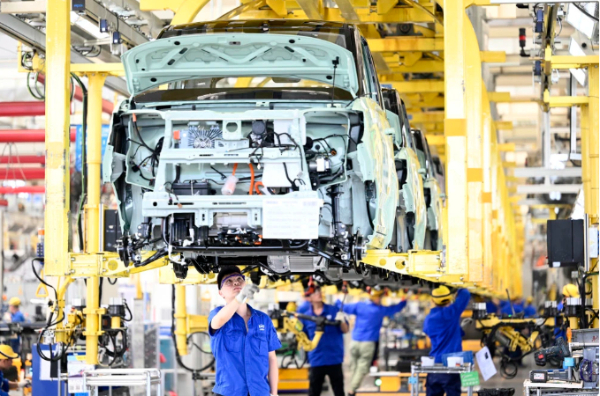
New Energy Vehicles Lead the Charge
In July 2023, China produced its 20 millionth new energy vehicle (NEV). By the end of 2023, the number of NEVs in operation in China reached 20.41 million. It took nearly 27 years for China to reach the first 10 million NEVs, but the second 10 million was achieved in just 1 year and 5 months, showcasing an astonishing growth rate.
Thanks to a strategic shift, China’s automotive industry has seized the historic opportunity of the NEV rise and is reshaping the global automotive landscape. China’s NEV advantage is evident: in the past year, domestically produced NEVs accounted for about two-thirds of global NEV production and sales, with an increasingly significant share in international markets.
According to the China Association of Automobile Manufacturers (CAAM), in 2023, China's NEV production and sales reached 9.587 million and 9.495 million units, respectively, representing year-on-year growth of 35.8% and 37.9%, with a market share of 31.6%.
The rapid growth of NEVs is clearly reflected in the data. With production and sales exceeding 9 million units in 2023 and a market share over 30%, the NEV industry continues to accelerate, moving toward an annual sales target of 10 million units. This growth is continually generating new momentum for the high-quality development of China’s economy.
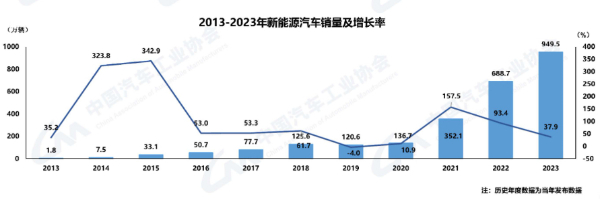
Data Source: China Association of Automobile Manufacturers
Zhang Yongwei, Vice Chairman of the China Electric Vehicle Hundred People's Association, recently stated that the latest models of the new generation of electric vehicles are mostly launched in China first, and the related technologies are often applied in Chinese-made products before other countries. This has laid a solid foundation for China's leadership in the new energy vehicle (NEV) industry.
Green and Low-Carbon Trends
"Promoting green and low-carbon development of the economy and society is key to achieving high-quality growth," Zhang emphasized. To meet the "dual carbon" targets, the "Automobile Industry Green and Low-Carbon Development Roadmap 1.0" released in December 2023 set the goal for the automobile industry to reach peak carbon emissions by 2030, and through continued efforts, to achieve carbon neutrality on schedule.
China has been dedicated to promoting the transition to green energy and low-carbon development, offering comprehensive support for the new energy vehicle industry. The "Opinions of the Central Committee of the Communist Party of China and the State Council on Fully Advancing the Construction of Beautiful China," issued on January 11th, states that "key areas of green and low-carbon development will be coordinated. By 2027, new energy vehicles are expected to account for 45% of all new cars, with old internal combustion engine vehicles largely eliminated."
Green and low-carbon development is not only a significant direction for the global automobile industry's transformation but also a key aspect of China's automobile industry to achieve high-quality growth. As a result, Chinese automakers are focusing on multiple technology paths, including pure electric, hybrid, and hydrogen fuel technologies. They are deeply exploring core technologies such as intelligence, battery systems, and electric controls, and are making substantial progress in the lithium battery and automotive electronics industry chain to accelerate the green development of the automobile industry.
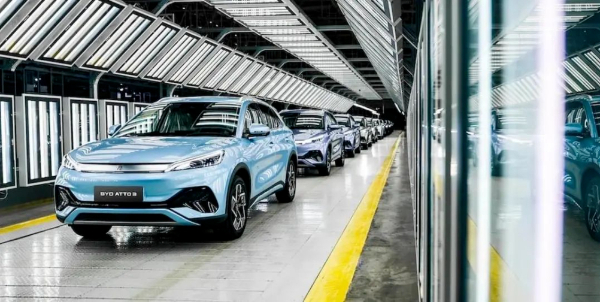
Policy Support for Continued Growth
China's new energy vehicle (NEV) development has entered a new stage of marketization, and policy support continues to inject fresh momentum into stimulating automotive consumption potential. In the past year, the Ministry of Industry and Information Technology, along with seven other government departments, jointly issued the "Automobile Industry Steady Growth Work Plan (2023–2024)" to support the expansion of NEV consumption.
To stabilize market expectations and promote high-quality development of the automobile industry, the Chinese government has extended the NEV vehicle purchase tax exemption policy until the end of 2027. The tax exemption will gradually phase out over the years, and the tax exemption for new energy passenger cars has been optimized from a full exemption to a limited amount. Additionally, the technical requirements for NEVs eligible for tax reduction have been updated. It is estimated that the total amount of vehicle purchase tax exemptions from 2024 to 2027 will reach 520 billion yuan.
In the past year, activities such as the "Hundred Cities Linked" Car Festival and the "Thousand Counties and Ten Thousand Towns" NEV Consumption Season, organized in accordance with the Ministry of Commerce's "2023 Consumption Stimulus Year" initiative, achieved significant results. Nearly 70 popular vehicle models, combined with car purchase subsidies, have further released the consumption demand for new energy vehicles. Moreover, the construction of charging infrastructure across regions has accelerated, supporting the adoption of NEVs in rural areas and promoting rural revitalization.
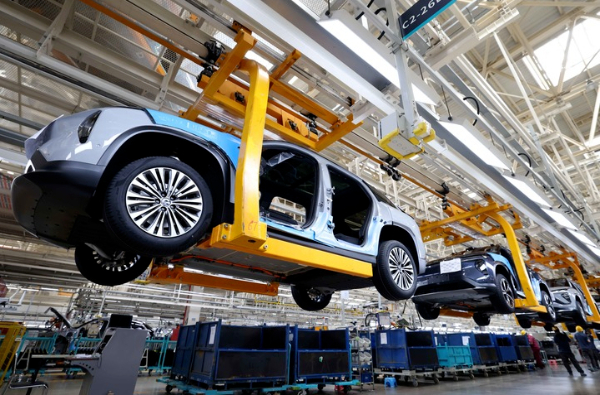
At the start of 2024, many regions have continued to introduce policies aimed at facilitating consumption. These include the issuance of consumer vouchers for physical goods such as automobiles and home appliances, as well as measures to stabilize large-scale consumption such as automobiles and housing.
During a recent press conference by the State Council Information Office, a representative from the National Development and Reform Commission (NDRC) stated that the government would work with relevant departments to refine policies and actively expand the consumption of new energy vehicles (NEVs) to promote high-quality industry development. The focus will be on the "three accelerations":
Accelerating the optimization of policies to promote NEV consumption, including expanding NEV outreach to rural areas and driving the electrification of public sector vehicles.
Accelerating technological innovation in NEVs to enhance electrification and intelligent technology levels.
Accelerating the construction of high-quality charging infrastructure, continuously improving and optimizing the charging network layout to support the development of the NEV industry.
In recent years, China's automotive industry has developed rapidly, with product performance and quality consistently improving. Notably, new energy vehicles (NEVs) have not only won the favor of domestic consumers but are also gradually gaining recognition and acceptance from global consumers, with export volumes increasing year by year. According to the China Association of Automobile Manufacturers (CAAM), China's NEV exports reached 1.203 million units in 2023, a 77.6% year-on-year increase, setting a new record.
China's NEV industry is transitioning from vehicle exports to overseas investments and factory setups, moving from "market-for-technology" to "technology output." Leveraging its first-mover advantage and smart applications, China's NEV industry is gradually becoming a global benchmark for the sector.
From the perspective of China's exports, the structure of exported goods continues to optimize and upgrade. The "old three" categories—clothing, home appliances, and furniture—are giving way to the "new three," represented by electric passenger vehicles, lithium-ion batteries, and solar cells. This shift reflects the new trend of high-quality development in China's economy.
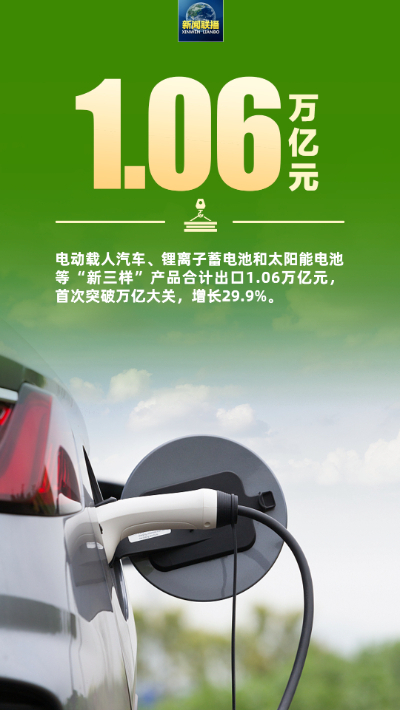
According to customs statistics, the total export value of "new three" products reached 1.06 trillion yuan in 2023, surpassing the trillion-yuan mark for the first time, with a growth rate of 29.9%. The overseas expansion of NEVs is driving the global expansion of the entire industry chain, not only contributing growth highlights to vehicle production and sales but also injecting vitality into China's foreign trade economy.
Local production and the establishment of comprehensive sales systems abroad are crucial strategies for automakers venturing into global markets. In 2023, Chinese new energy vehicle (NEV) companies expanding internationally accelerated their overseas production base setups. Car manufacturers like GAC, Changan, and NETA have started constructing overseas production facilities for passenger vehicles and key NEV components in Southeast Asia. In December 2023, BYD announced the establishment of an NEV production base in Szeged, Hungary. At the beginning of 2024, Great Wall Motors' electric vehicle brand, Ora, launched its manufacturing base in Rayong, Thailand.
These steps highlight the Chinese NEV industry's accelerated global expansion. By investing in overseas factories and bringing advanced technology and products, Chinese automakers are allowing more global users to enjoy the benefits of technological progress. Zhang Yongwei predicts that a major highlight of China's NEV internationalization in 2024 will be the increasing proportion of overseas production and sales.
As China's automotive industry chain continuously improves, the supporting industry ecosystem is further optimized, pushing NEVs into a new stage of rapid development. China has already formed large NEV industrial clusters in regions such as the Yangtze River Delta, Pearl River Delta, Beijing-Tianjin-Hebei, Chengdu-Chongqing, and Northeast China.
Taking the Yangtze River Economic Belt as an example, automotive companies such as Changan Auto and Seres in Chongqing, Dongfeng Motor in Hubei, Chery, JAC Motors, and NIO in Anhui, and SAIC and Tesla in Shanghai are driving the development of NEV clusters along with their upstream and downstream industries. This collective formation of industrial hubs has accelerated the growth of NEVs in these areas.
The rapid growth in NEV production and sales reflects the strength of the entire supply chain. For instance, in the field of power batteries, six of the top ten global power battery manufacturers in 2023 were Chinese companies, accounting for over 60% of the market share, giving China a strong competitive edge globally.
Leveraging China's first-mover advantage in the new energy sector, a well-structured, organically coordinated NEV industry chain is emerging, strengthening its competitiveness in the global market.
The shift toward electrification and smartification is reshaping the automotive industry's value chain. NEVs are continuously upgrading toward better smart experiences and advanced autonomous driving capabilities. A complete industrial chain, solid core technologies, and increasingly widespread charging infrastructure have made green travel more appealing to consumers worldwide.
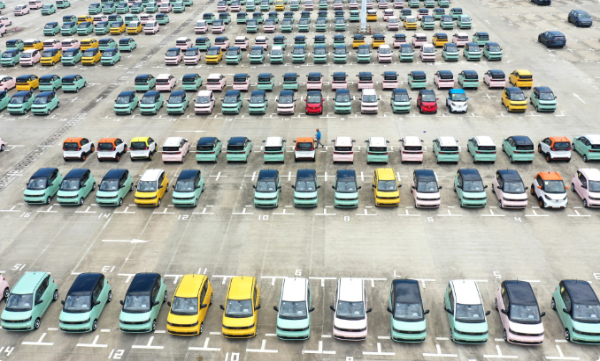
New energy vehicles (NEVs) are a key direction for the global automotive industry's transformation and green development, and also represent a strategic choice for China's high-quality automotive industry growth. Xu Haidong, deputy chief engineer of the China Association of Automobile Manufacturers, stated, "In 2024, NEVs and automotive exports will remain the main drivers of China's automotive industry."
Zhang Yongwei predicts, "In 2024, China's automotive growth momentum will continue, and the production and sales of NEVs are expected to reach 13 million units, with an overall penetration rate potentially exceeding 40%." As the competitiveness of Chinese NEVs continues to strengthen globally, market vitality and consumption potential will be further stimulated. The future of NEV development looks promising, and it will play a leading role in the transformation and upgrading of China's manufacturing industry.
ADD: No. 10 Shengyuan Road, Huangtang Village, Danxi Town, Yueqing City, Wenzhou City, Zhejiang Province
C.P.: Mr.Lin
TEL: +86 15058777898
 Mobile version